
Understanding HAPV: The Real Roots of Karate Self-Protection
When you strip away the sport, the conditioning, the belt colors, and the social media techniques, traditional karate — especially Okinawan karate — was built for one thing:
Surviving real human violence.
Patrick McCarthy, Hanshi, brought this to the forefront through his research into the Bubishi, often referred to as the “Bible of Karate.” Inside that text, he identified something that makes self-defense far more realistic and far more practical:
HAPV — Habitual Acts of Physical Violence.
HAPV are the common, predictable ways human beings attack each other in real confrontations. They are not fancy. They are not technical. They are not trained.
But they happen every single day in street altercations.
Understanding HAPV is the bridge between kata and real application.
It’s the key to understanding why your forms, drills, and bunkai look the way they do — and how they were originally meant to save your life.
What Are HAPV?
A Habitual Act of Physical Violence is any natural, untrained, instinctive way that a person might strike, grab, or assault another person.
They come from:
- panic
- fear
- anger
- alcohol
- surprise
- adrenaline
- territorial dominance
Most people do not attack like trained fighters.
They attack like humans — with instinct, not structure.
The genius of old-school karate is that it memorized, cataloged, and encoded responses to these common human attacks inside kata.
Kata isn’t choreography.
It’s a catalog of surviving common violence, like a blueprint for handling the attacks you’re most likely to face in the real world.
Why HAPV Matter for Real Self-Defense
When you train techniques without understanding what attack they’re meant for, you’re shadowboxing fantasy.
When you train HAPV-based bunkai, everything suddenly makes sense — and becomes brutally functional.
You learn:
- Why certain blocks look “weird”
- Why angles, seize-and-control movements, and close-range tactics are built into kata
- Why striking and grappling are blended instead of separated
- Why Te (striking) breaks posture before Jitsu (manipulation)
Training against HAPV teaches you to handle:
- non-technical grabs
- wild, committed swings
- chaotic forward pressure
- sudden sucker punches
- ambush-style attacks
- stress-based aggression
This is what real violence looks like.
And that’s what karate was originally made for.
The 36 HAPV According to Patrick McCarthy
Here is the complete list of HAPV commonly referenced in McCarthy’s analysis:
Striking HAPV
- Right roundhouse haymaker punch
- Left roundhouse haymaker punch
- Straight lunging punch (right hand)
- Straight lunging punch (left hand)
- Overhand “bomb” punch
- Backhand swing
- Two-handed shove
- Slap to the face (open hand)
- Hooking palm-heel strike
- Headbutt
- Low kick to the knee or shin
- Stomping kick downward
- Wild charging flurry (windmill punches)
- Grabbing punch (they grab your shirt and hit)
- Uppercut-style swing
- Elbow strike in close
- Hammerfist downward strike
- Knee strike to groin or thigh
Grabbing / Holding HAPV
- Single lapel grab (right hand)
- Single lapel grab (left hand)
- Double lapel grab
- Wrist grab (same side)
- Wrist grab (cross grab)
- Two-handed wrist grab
- Hair grab
- Arm drag / pulling grab
- Bear hug from front (arms free)
- Bear hug from front (arms pinned)
- Bear hug from behind (arms free)
- Bear hug from behind (arms pinned)
Clinching / Seizing HAPV
- Tackle or body charge
- Grabbing around one leg
- Side headlock
- Guillotine headlock (front headlock)
- Clothing hold + punching combination
- Choke / throat grab (one hand or two)
These attacks appear again and again in police reports, assault statistics, bar fights, parking-lot violence, and real-world altercations across decades.
Which means:
If you can defend against these, you can defend against 90% of human violence.
How We Use HAPV in Training
At OSOT, we emphasize realism and function over choreography. That means:
- We take a kata sequence.
- Identify the HAPV it originally addressed.
- Train the real attack.
- Apply Te (strike) to break posture.
- Apply Jitsu (lock, throw, takedown, escape) to finish safely.
This is the heart of karate as it was intended: a civilian self-protection method built around how humans actually attack.
When you study HAPV, you understand the purpose behind every movement — and you train not for a dojo match, but for real survival.
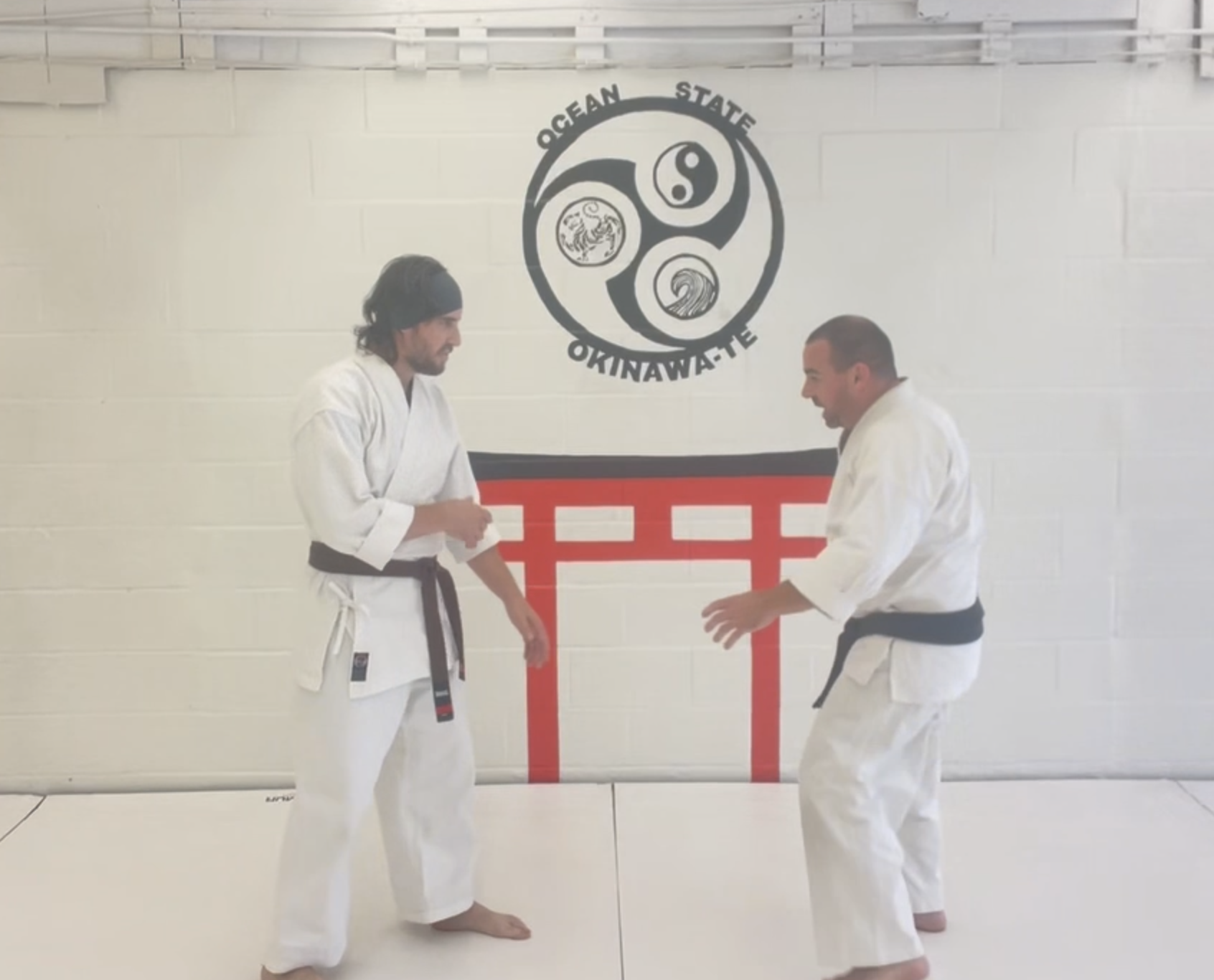
Function Over Form
Are you ready to build real-world confidence, sharpen your awareness, and train in a system built for true self-protection? Ocean State Okinawa-Te is here for you. Check out our Family & Adult classes to see what authentic Okinawan karate can do for you. Come train, grow, and discover what your body and mind are capable of.